Best Greyhound Betting Sites – Bet on Greyhounds in 2026
Loading...
British greyhound racing spans nearly a century, from a single experimental meeting in Manchester to an industry that once rivalled football for popular attention. The story involves spectacular growth, cultural significance, painful decline, and ongoing adaptation. Understanding this history helps explain why the sport looks the way it does today.
The timeline runs from 1926 to the present, passing through a golden age when 75 million people attended meetings annually, then through decades of contraction that saw most tracks close forever. What remains is a smaller but still substantial industry, regulated differently than in its early years and facing questions about its future that would have seemed unthinkable when the sport was at its peak.
This guide traces the major periods and turning points in UK greyhound racing history, providing context for anyone seeking to understand how the modern sport emerged from its origins.
The Early Years
Greyhound racing arrived in Britain on 24 July 1926 at Belle Vue Stadium in Manchester. American entrepreneur Charles Munn, who had seen oval track racing succeed in the United States, partnered with British investors to stage the first meeting. The mechanical hare, essential to the modern sport, circled the track on a rail while six dogs chased it around the bends. Around 1,700 spectators watched that inaugural event, witnessing the birth of a new British institution.
The sport expanded with remarkable speed. Within months of the Belle Vue opening, tracks began appearing across Britain. White City in London opened later in 1926, followed rapidly by venues in Birmingham, Glasgow, Edinburgh, and dozens of other cities. By 1927, greyhound racing had established itself as a genuine mass entertainment phenomenon attracting audiences that surprised even its promoters.
The appeal was straightforward. Greyhound racing offered excitement accessible to working-class audiences who found horse racing expensive and socially distant. Meetings took place in the evenings, fitting around work schedules. Admission was affordable. The atmosphere was democratic in ways that other sports were not. Factory workers could stand alongside professionals, united in watching the dogs run.
The betting element drove much of the interest. Legal on-course gambling gave punters a reason to engage beyond mere spectating. The rapid succession of races, typically six dogs running over less than thirty seconds, created continuous action and betting opportunities. Where horse racing might offer a dozen races across an afternoon, greyhound meetings packed similar numbers into a shorter evening programme.
Regulation developed alongside growth. The National Greyhound Racing Club formed in 1928 to establish rules, license tracks, and maintain standards. This governing body distinguished licensed tracks from unlicensed independent venues, creating a two-tier structure that would persist for decades. Licensed racing carried prestige and regulatory oversight that the independent sector lacked.
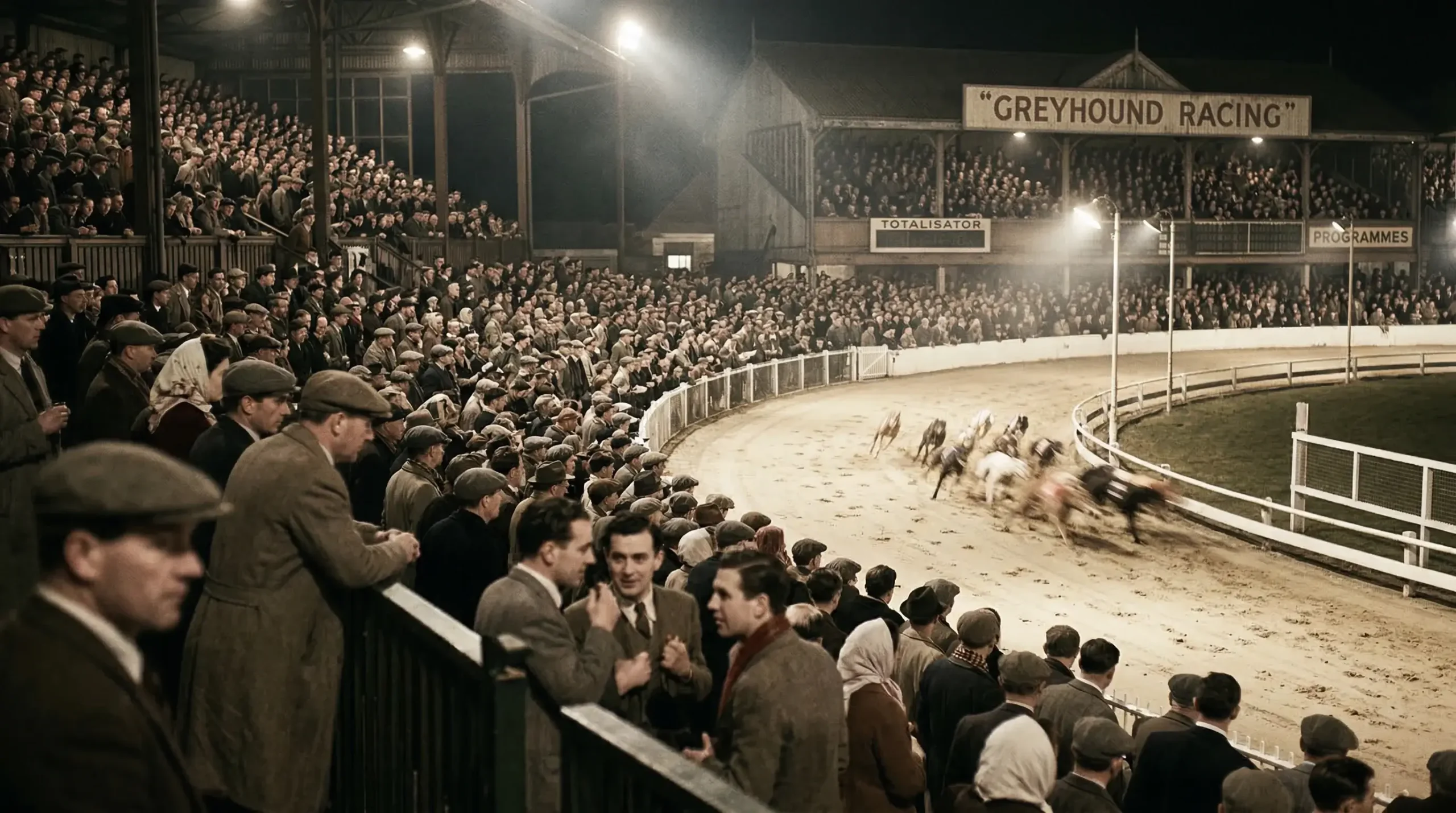
By the early 1930s, greyhound racing had become embedded in British working-class culture. The dogs drew crowds that rivalled football in some cities. Famous greyhounds like Mick the Miller achieved celebrity status, appearing in films and becoming household names. The sport had arrived, and it showed no signs of stopping.
The Golden Age
The immediate post-war period marked greyhound racing’s absolute peak. In 1946, attendance reached 75 million visits across British tracks, a figure that seems almost impossible today. The sport had become the second most popular spectator activity in the country, trailing only football. Every major city had multiple tracks, and smaller towns often supported venues too. This was mass entertainment on a scale that few sports have ever achieved.
At this peak, Britain had 77 licensed tracks operating under National Greyhound Racing Club rules, plus over 200 independent venues running outside the regulatory framework. London alone supported more than a dozen major stadiums. White City, Wembley, Wimbledon, Harringay, Catford, New Cross, and others drew vast crowds on race nights. The capital’s greyhound scene was genuinely substantial, offering entertainment options across different neighbourhoods.
The social dimension mattered as much as the sport itself. Going to the dogs was an event, not merely entertainment. People dressed for the occasion. Restaurants and bars at tracks served as meeting places for communities. The atmosphere combined sporting excitement with social ritual in ways that created loyal, regular audiences who returned week after week throughout the year.
Prize money reflected the sport’s prosperity. Top trainers and owners earned substantial incomes. Champion dogs became valuable commodities. The industry supported thousands of jobs directly and many more indirectly through related services. Greyhound racing was economically significant in ways that extended far beyond the tracks themselves.
The golden age could not last indefinitely. Television began changing how people spent their evenings. Other entertainment options multiplied. The social patterns that had made greyhound racing so popular started shifting. But for roughly two decades after the war, the sport enjoyed a prominence in British life that it would never recapture.
Decline and the Modern Era
The decline began gradually in the late 1950s and accelerated through subsequent decades. Between 1960 and 2010, 91 NGRC-licensed tracks closed permanently. The reasons were multiple and reinforcing. Television kept people at home. Car ownership enabled other leisure activities. Property values made stadium sites worth more as development land than as racing venues. Each closure reduced the sport’s visibility, making further contraction more likely.
London’s greyhound scene collapsed almost entirely. White City closed in 1984. Wimbledon survived until 2017 despite sustained campaigns to save it. Crayford held on until 2025. Today, only Romford remains within the Greater London area, a lone survivor of what was once a thriving metropolitan circuit. The capital that once supported over a dozen major tracks now has just one.
Critics have intensified scrutiny of welfare standards. Eve Massie Bishop of OneKind has stated that the sport has cost the lives of 3,957 dogs since 2017, citing data that advocates use to argue for bans. Legislative efforts in Wales and Scotland have advanced proposals to prohibit greyhound racing entirely, reflecting changing attitudes toward animal welfare in sport.
The modern industry operates under GBGB regulation with 18 licensed tracks. Attendance is a fraction of golden age levels, but betting turnover remains substantial, supporting the commercial viability of remaining venues. Media rights, particularly for BAGS racing broadcast to betting shops, provide revenue streams that complement declining gate receipts.
Welfare initiatives have expanded significantly. Retirement schemes fund rehoming of dogs after racing careers end. Injury reporting has become more transparent. Industry bodies point to improving statistics as evidence of genuine progress on welfare concerns. Whether these measures satisfy critics remains contested, but the modern sport operates under closer scrutiny than at any previous time in its history.
The future remains uncertain. Further track closures seem likely as property economics continue to pressure stadium sites. Legislative bans could spread beyond Wales and Scotland. Yet the sport retains a dedicated following, betting interest persists, and the infrastructure for racing continues to function. Nearly a century after Belle Vue, greyhound racing endures in Britain, diminished but not extinguished, facing challenges that would have seemed unimaginable in 1946 but adapting as circumstances demand.