Best Greyhound Betting Sites – Bet on Greyhounds in 2026
Loading...
Two prices dominate greyhound racing results: the traditional Starting Price and Betfair’s exchange-calculated alternative. Both claim to represent fair value at the moment the traps open, yet they derive from entirely different mechanisms and often diverge by significant margins. Understanding how each works — and when one outperforms the other — matters for anyone serious about greyhound betting.
The distinction runs deeper than mere calculation methods. Traditional SP reflects bookmaker opinion shaped by on-course betting, while Betfair SP emerges from peer-to-peer exchange activity where punters set the odds themselves. Each system carries advantages and limitations. Knowing which to use, and when, separates methodical punters from those leaving value on the table.
This guide breaks down both mechanisms, examines where they diverge, and offers practical guidance on choosing between them. Whether you bet occasionally or systematically, understanding these two price formation systems will sharpen your approach to greyhound wagering.
Traditional Starting Price: How It Works
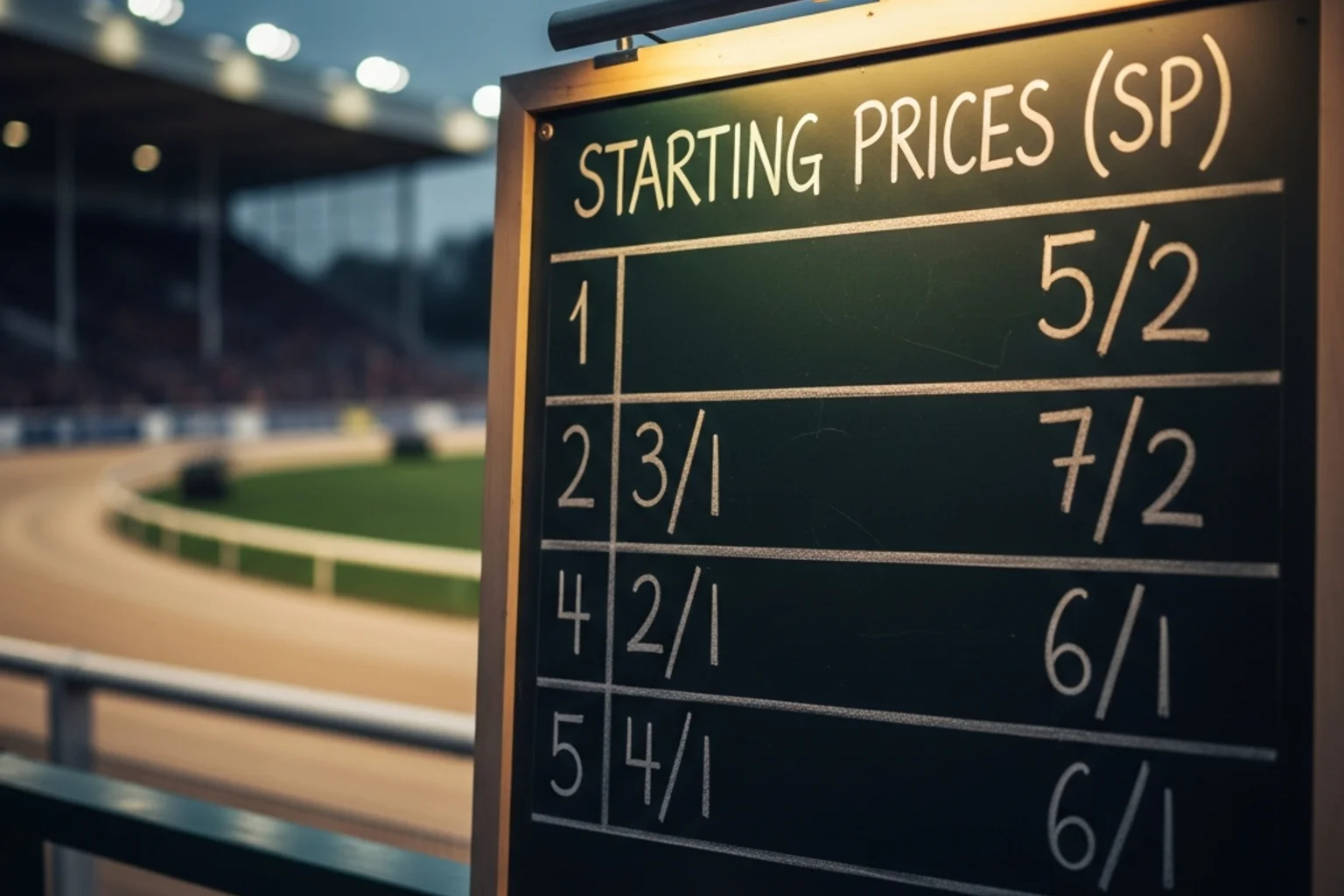
The Starting Price has governed UK greyhound and horse racing since betting became formalised. An official SP reporter attends the track, observes the on-course bookmakers’ boards as the race approaches, and records the prevailing odds when the hare begins its run. These odds become the official Starting Price, used to settle bets placed at SP with off-course bookmakers and betting shops.
The process relies on the presence of on-course bookmakers, who adjust their odds based on the money they receive. When punters pile into a particular greyhound, its price shortens; when a dog attracts little interest, its odds drift. The SP reporter captures this final state of the market, creating a snapshot of collective opinion at race time.
For greyhound racing, SP formation presents specific challenges. Unlike horse racing, where multiple on-course bookmakers compete at major meetings, many greyhound tracks host limited on-course betting activity. The UK’s greyhound betting market generates substantial turnover — approximately £1.5 billion annually across all channels according to Gambling Commission data — but much of this flows through off-course shops and online platforms rather than trackside bookmakers.
This concentration means SP formation can depend on relatively thin on-course markets. A single large bet at a quiet BAGS meeting might move the price significantly, affecting every SP punter’s return. The system assumes robust on-course competition that doesn’t always exist at every meeting. BAGS fixtures, in particular, often proceed with minimal on-course betting, raising questions about whether the resulting SP truly reflects market consensus.
Despite these limitations, SP remains the industry default. Bookmakers guarantee SP returns for punters who don’t take fixed odds, providing certainty that your bet will be settled at whatever price emerges at race time. For recreational punters who cannot monitor markets constantly, SP offers simplicity: you back a dog to win, and the market determines fair value at the off.
Betfair SP: The Exchange Alternative
Betfair Starting Price operates on fundamentally different principles. Rather than capturing bookmaker boards at a single moment, BSP calculates from unmatched bets sitting on the exchange when the race starts. The algorithm identifies the price point where the volume of back bets (punters wanting the dog to win) meets the volume of lay bets (punters betting against), producing a market-clearing price.
This peer-to-peer model eliminates the bookmaker from odds formation. No single entity sets the price; instead, thousands of punters collectively determine value through their willingness to back or lay at various odds. The resulting BSP reflects genuine market equilibrium rather than one party’s opinion of fair odds.
Exchange mechanics create different dynamics than traditional betting. Liquidity matters enormously: a well-traded greyhound race will generate substantial matched betting, producing reliable BSP figures. A thinly traded event might see BSP determined by small volumes, potentially creating distorted prices. Major UK greyhound meetings typically attract decent exchange activity, while obscure fixtures may not.
The commission structure also differs. Betfair charges winning bets a percentage commission rather than building margin into odds as traditional bookmakers do. This means BSP punters pay explicit commission on profits but avoid the implicit margin that reduces fixed odds. For consistent winners, this structure proves advantageous; for occasional punters, the difference matters less.
BSP also enables strategies impossible with traditional betting. Punters can request BSP at the point of bet placement, knowing the final price will emerge at race time based on market activity. They can also set minimum odds requirements: a bet might specify BSP only if it reaches 4.0 or better, automatically cancelling if the dog trades too short. This flexibility attracts sophisticated punters who value control over bet execution.
Comparing SP and BSP: Which Offers Better Value
Systematic comparison reveals BSP frequently outperforms traditional SP, particularly for winning favourites. Exchange markets attract sharp punters who drive prices to efficient levels, while on-course bookmaker markets sometimes lag behind. When a well-fancied greyhound wins, BSP often returns more than SP, reflecting tighter exchange margins.
The advantage reverses for longer-priced winners. Traditional bookmakers sometimes offer generous SP on outsiders, either through error or because thin on-course markets fail to shorten speculative selections. Exchange BSP tends to capture these opportunities more efficiently, meaning big-priced winners occasionally pay better at SP than BSP.
Liquidity differences create further variation. Major evening meetings at Romford or Nottingham generate substantial exchange trading, producing reliable BSP across the card. Afternoon BAGS fixtures attract less exchange interest, potentially creating volatile BSP figures. Traditional SP, while imperfect, at least offers consistency: the SP reporter records whatever the on-course boards show, regardless of betting volume.
Best Odds Guaranteed promotions complicate the comparison. Many traditional bookmakers offer BOG on greyhound racing, paying the higher of your fixed odds or SP if the price drifts. This protection eliminates downside risk from taking early prices. Exchange betting offers no equivalent guarantee — you receive BSP regardless of where the market moves after your bet placement.
The choice often depends on betting style. Systematic punters tracking value across hundreds of bets typically favour exchange BSP, accepting small variations for overall better margins. Casual punters taking occasional bets often prefer traditional bookmakers, where SP guarantees, BOG, and promotions offset any theoretical edge BSP might provide. The British Greyhound Racing Fund collected £6.75 million from bookmaker contributions in the 2024-25 fiscal year, evidence that traditional betting remains central to the sport’s economics.
Timing also plays a role. Exchange markets become more liquid as race time approaches, meaning early BSP requests carry more uncertainty than those placed moments before the off. Punters comfortable monitoring markets can wait for optimal conditions; those placing bets hours in advance accept whatever BSP emerges. Traditional SP, by contrast, always represents the final market state, removing timing decisions from the equation.
Practical considerations matter too. Taking BSP requires a Betfair account and acceptance of commission structures. Traditional SP remains available through every licensed bookmaker. For punters placing bets in betting shops, where much UK greyhound wagering still occurs, SP is simply the default option. The theoretically superior price means nothing if accessing it proves inconvenient.
Neither option dominates in all circumstances. BSP tends to provide better value for favourites at well-attended meetings, while traditional SP sometimes pays more on outsiders at minor fixtures. The sophisticated approach involves having access to both and choosing based on specific circumstances: the meeting, the dog’s expected price range, and the likely liquidity in each market. For most punters, however, consistency trumps optimisation — picking one system and understanding it thoroughly beats constantly switching between approaches.