Best Greyhound Betting Sites – Bet on Greyhounds in 2026
Loading...
Walk into any British greyhound stadium, and the first thing you notice is colour. Six dogs line up behind the traps, each wearing a jacket that screams its starting position to thousands of spectators craning their necks. Red, blue, white, black, orange, and those distinctive black-and-white stripes. This is not fashion. This is function perfected over nearly a century of racing.
The greyhound trap colour system exists because, frankly, telling one sprinting dog from another at 45 miles per hour is otherwise impossible. When six greyhounds explode from the traps and barrel towards the first bend in a blur of legs and sand, you need something unmissable. The jacket system solves this problem with elegant simplicity: trap one wears red, trap two wears blue, and so on. The same sequence applies across all 18 GBGB-licensed stadiums operating in Britain today, making the system universal whether you are watching at Romford or Monmore.
The Six-Colour System
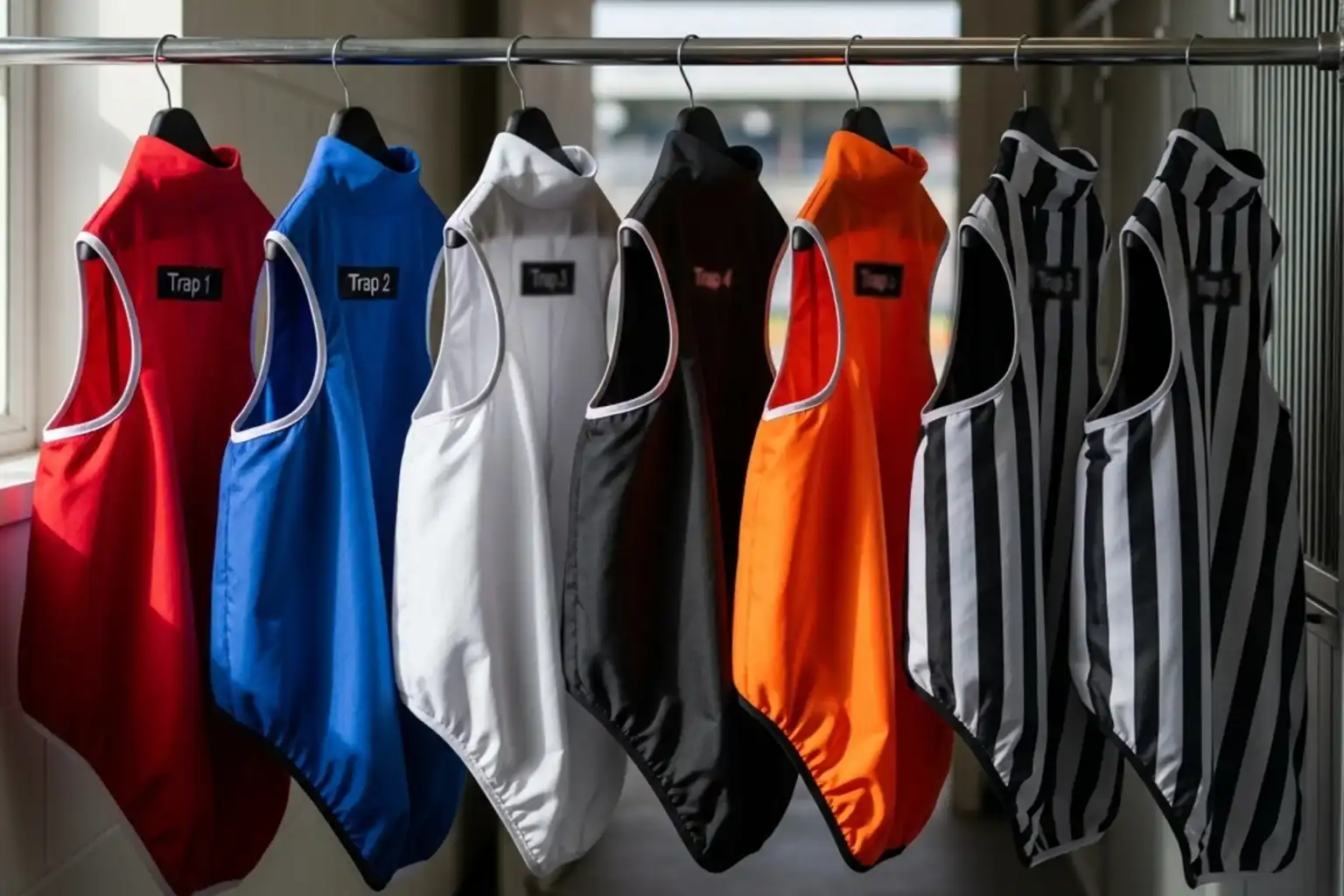
Each trap number corresponds to a specific colour, and this pairing never changes. Trap 1 is always red. Trap 2 is always blue. Trap 3 is always white. Trap 4 is always black. Trap 5 is always orange. Trap 6 is always black and white stripes. Commit these to memory, and you will never lose your dog again.
The colours were chosen for maximum visibility and contrast. Red and blue are instantly distinguishable even under floodlights. White stands out against the sand. Black works because it contrasts with both the track surface and the paler coats of many greyhounds. Orange was a later addition to replace yellow, which proved harder to spot at speed. The striped jacket for trap six solves the problem of finding a sixth distinct colour by combining black and white in a pattern that reads differently from solid black.
Jackets are made from lightweight nylon or similar synthetic fabrics. They sit snugly against the dog without restricting movement, with straps under the chest and around the neck. Before each race, kennel staff fit the appropriate jacket to each greyhound based on its assigned trap number. This assignment is determined by the racing manager when drawing up the card, taking into account factors like the dog’s running style and recent form.
The standardisation of trap colours is relatively recent in historical terms. Early greyhound racing, which began at Belle Vue in 1926, used various identification methods. The National Greyhound Racing Club eventually codified the six-colour system to ensure uniformity across all licensed tracks. This standardisation means a punter who learns the system at one track can immediately apply that knowledge anywhere else in Britain.
Some tracks historically experimented with slight variations, using different shades or adding track logos to jackets. However, GBGB regulations now mandate consistent colours to maintain the integrity of the identification system. The jackets you see at Towcester are identical in colour to those at Sheffield or Nottingham.
Trap Statistics and Performance
Trap numbers influence racing outcomes more than casual observers might expect. The inside traps, particularly traps 1 and 2, often enjoy statistical advantages in sprint races because they have the shortest run to the first bend. Dogs breaking from these positions can save ground by hugging the inside rail. Across 355,682 races run in 2024, analysts have documented consistent patterns in how trap position affects finishing results.
The physics are straightforward. On a standard oval track, the first bend comes up quickly after the start. A dog on the inside needs to travel less distance than one on the outside. At Romford, for instance, the first bend arrives after roughly 90 metres. In that short sprint from the traps, inside dogs can establish position before wider runners have a chance to cut across.
This does not mean trap 1 always wins. Racing managers carefully consider each greyhound’s running style when assigning traps. A dog that tends to run wide will be placed in an outside trap to avoid interference. A railer, which is a dog that prefers to run close to the inside rail, will often be drawn in traps 1 or 2 to exploit its natural racing line. A middle-running dog might find trap 3 or 4 ideal, giving it room to manoeuvre either way off the first bend.
Trap statistics vary significantly between tracks. A stadium with tight bends might favour inside draws more heavily than one with sweeping curves. Longer races, particularly stayers events over 600 metres or more, reduce the trap advantage because dogs have more time to find their preferred positions. Studying trap statistics for specific tracks is a worthwhile exercise for anyone serious about understanding race dynamics.
Television coverage and streaming services display trap colours prominently in their graphics. On-screen overlays typically show small coloured squares or circles next to each dog’s name in the running order. This visual shorthand allows viewers to instantly connect the information displayed with the action on screen. When a commentator says the orange jacket has hit the front, you can glance at the overlay and know immediately which dog is now leading.
Practical Tips for Following Races
Learning the trap colours transforms your experience of watching greyhound racing. Instead of squinting at a mass of dogs, you pick out your selection immediately. Red in front? That is trap 1 leading. Stripes making ground on the outside? Trap 6 is closing. The race becomes readable.
Start by memorising the sequence: red, blue, white, black, orange, stripes. Some people use mnemonics. Others simply watch enough races that the association becomes automatic. Either approach works. The key is consistency, which is precisely what the system provides.
When watching on television or streaming, commentators will refer to dogs by both their trap number and colour. You might hear something like trap four in black making a challenge, or the red jacket is fading. These references assume familiarity with the system, and now you have it.
In betting shops, screens display racing from multiple tracks throughout the day. The trap colour system allows punters to follow several meetings simultaneously without confusion. A quick glance tells you which dog is which, regardless of whether the race is from Sunderland in the morning or Towcester in the evening. The same red jacket means the same trap position everywhere.
At the track, the colours become even more useful. From the grandstand, you are often watching from an angle that makes reading race numbers on jackets difficult. Colours, however, remain visible. You can follow your selection through the entire race without ever losing sight of it. Even in poor weather conditions or under artificial lighting, the high-contrast colours remain distinguishable.
One final observation. Experienced punters often develop instincts about certain trap colours at specific tracks. Someone might notice that orange jackets perform unusually well at Perry Barr, or that stripes struggle at certain venues. These patterns are not superstition. They reflect genuine statistical variations in how different trap positions interact with track geometry. The colours become a shorthand for understanding these dynamics, a visual language that speaks to how races unfold.
The trap colour system is one of those details that separates casual viewers from genuine followers of the sport. Once you know it, you cannot unsee it. Every race becomes a choreography of colours, each jacket telling you exactly where to look. Red chasing blue into the first bend. White coming through on the inside. Orange fading on the run to the line. The colours are your guide to reading the race in real time, and that knowledge makes all the difference.