
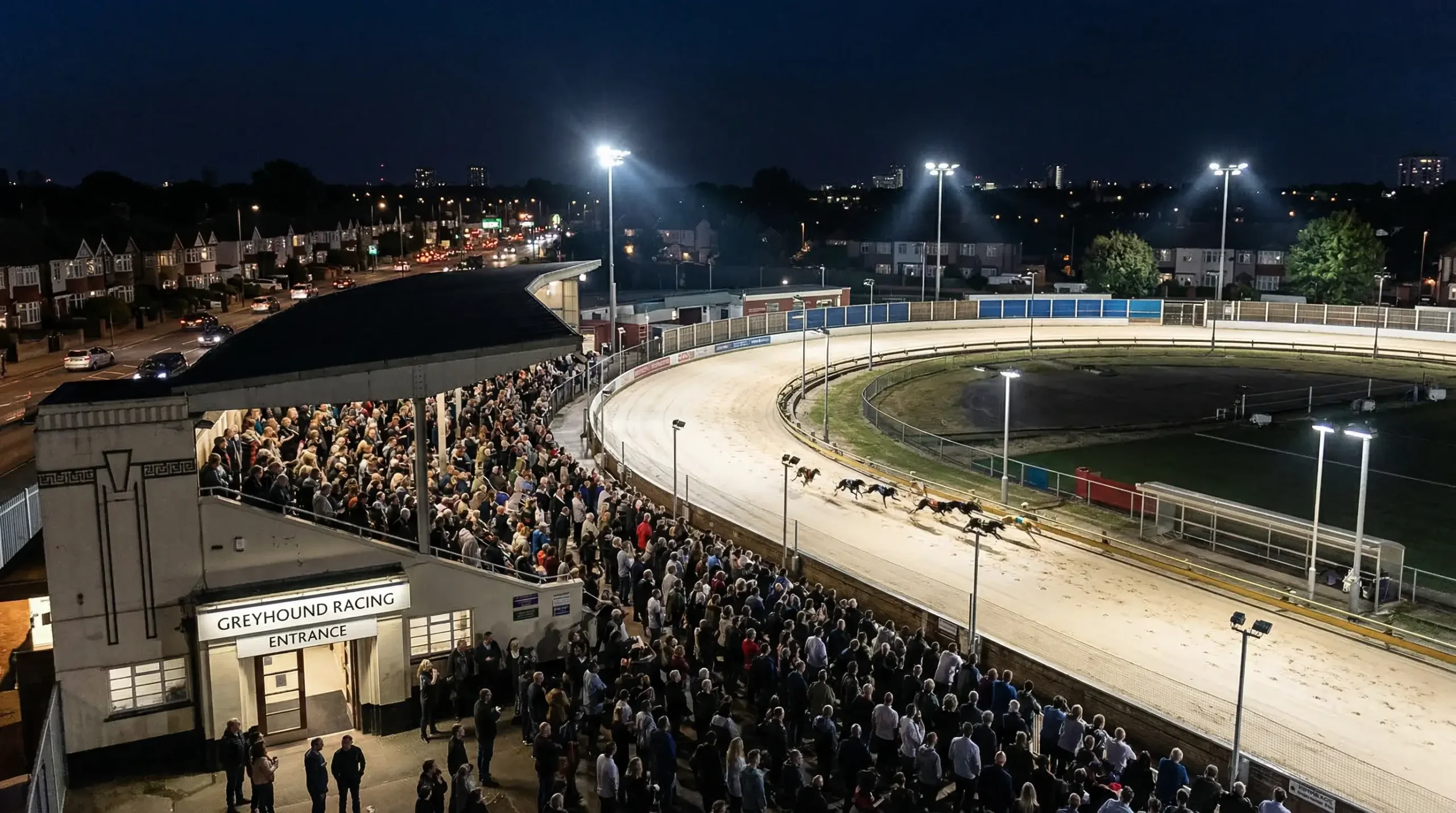
Romford Greyhound Stadium holds a distinction no other track in Britain can claim: it is the only greyhound venue remaining in London. After Crayford’s closure in 2025, Romford became the sole survivor of a once-thriving metropolitan racing scene that had sustained more than a dozen tracks at its peak. For anyone in the capital wanting to experience live greyhound racing, Romford is now the only option within the M25. The wider context is set out in our UK greyhound track results guide.
The stadium sits in Essex, technically just outside the Greater London boundary but firmly within the London commuter belt and easily reachable from central London. Its survival reflects both commercial resilience and the continued appetite for greyhound racing among Londoners and Essex residents alike. While the sport has contracted dramatically from its mid-century peak, when Britain supported 77 licensed tracks, Romford keeps the tradition alive in a region that once supported dozens of venues.
This guide covers Romford’s history, its facilities, and everything you need to know about visiting London’s last remaining dog track.
History of Romford Stadium
Romford Stadium opened for greyhound racing in 1929, just three years after the sport arrived in Britain at Belle Vue Manchester. The venue joined a rapidly expanding network of tracks serving the working-class entertainment market. By the 1940s, Britain had 77 licensed tracks and over 200 independent venues, with London alone supporting more than a dozen major stadiums attracting crowds that rivalled football.
The sport’s golden age saw massive crowds at tracks across the capital. White City, Wembley, Wimbledon, Harringay, and others drew tens of thousands on race nights. Romford operated alongside these famous names, establishing itself as a fixture of East London and Essex sporting life. The social scene mattered as much as the racing, with attendees dressing up for evenings at the dogs. Race nights were events, not mere sporting fixtures.
Decline came gradually, then accelerated. Television, changing leisure habits, and rising property values all worked against greyhound stadiums in urban areas. London tracks closed one by one over the decades. White City went in 1984. Wimbledon followed in 2017 despite fierce local opposition and campaigns to save it. Crayford, Romford’s nearest competitor, held on until 2025 before finally succumbing to development pressure.
Through all of this, Romford survived. The stadium has changed hands multiple times and undergone various refurbishments, but racing has continued without significant interruption. Management has adapted to changing circumstances, introducing new revenue streams and updating facilities to remain commercially viable when many competitors could not sustain their operations.
Romford’s survival reflects its geographical advantage. Located near major roads and with adequate parking, the stadium remains accessible in ways that inner London sites could not match. The surrounding area has not faced the same intense development pressure as locations closer to central London, allowing racing to continue without property valuations overwhelming the business case for continued operation.
Facilities and Track
The track at Romford measures 400 metres in circumference, a size that creates tight, competitive racing with the first bend coming up quickly after the start. Standard race distances include 225, 400, 575, and 750 metres, offering variety from sharp sprints to genuine staying tests. The surface is sand-based and maintained to GBGB standards, with regular inspections ensuring consistent racing conditions throughout the year.
The grandstand provides covered viewing and houses the main bars and restaurant facilities. Trackside areas offer closer views of the racing action for those who prefer to be near the running rail, though exposure to weather is the trade-off. On cold or wet nights, the covered areas fill quickly with regulars who know the value of shelter.
Food and drink options cover standard stadium fare. Bars serve throughout meetings, and food outlets offer hot meals and snacks. Corporate hospitality packages are available for groups seeking a more premium experience, with dedicated areas and inclusive catering arrangements for private events and celebrations.
The tote operates at the track, allowing pool betting alongside bookmaker prices. On-course bookmakers stand in their traditional positions, offering fixed odds on each race. The betting ring retains something of the atmosphere of older times, with prices chalked on boards and shouted between punters and layers. This direct interaction distinguishes track betting from online alternatives.
Parking is available on site, a significant advantage for a London-area venue where street parking would be problematic. The car park fills on popular nights, so arriving early is advisable for major meetings. There are no charges for parking on standard race nights, which helps keep the overall cost of attendance reasonable.
The venue caters to families on certain occasions, though evening racing naturally attracts an adult crowd. Special events and promotions run throughout the year, attempting to bring new audiences to the sport alongside the committed regulars who attend week after week. First-time visitors often find the atmosphere welcoming, with fellow racegoers happy to explain the basics of betting and form reading.
Practical Information
Romford Stadium is located on London Road in Romford, Essex, postcode RM7 9DU. By car, the venue is accessible from the A12 and A127, with clear signposting from major routes. The car park opens well before racing begins, and leaving promptly after the last race avoids the worst of the traffic in the surrounding streets.
Public transport options exist but require planning. Romford railway station is served by the Elizabeth Line and Greater Anglia services from Liverpool Street, providing direct connections from central London. From the station, the stadium is roughly a mile away, walkable but not conveniently close. Buses run along London Road, providing links to the station and surrounding areas for those preferring not to walk.
Racing typically takes place on Tuesday, Thursday, Friday, and Saturday evenings, with some daytime meetings for BAGS racing broadcast to betting shops. The evening schedule usually sees first race around 7:30pm, with the last race approximately three hours later. Exact times vary by meeting, so checking the card before attending is sensible practice.
Admission prices are reasonable for London entertainment, with concessions for seniors and children where accompanied by adults. Special promotions occasionally offer discounted entry, particularly for quieter midweek meetings. Membership schemes provide regular attendees with benefits including priority access and discounts on food and drink.
The atmosphere at Romford retains something of the traditional greyhound racing experience that has largely disappeared from British life. Regulars know each other, trainers are accessible between races, and the scale remains human despite the professional racing operation. This intimacy distinguishes track attendance from watching on screens, offering a social experience alongside the sporting one. very other venue is listed in the stadium directory.
For Londoners, Romford represents the accessible option for live greyhound racing without travelling far from home. The capital’s last dog track continues a tradition stretching back nearly a century, adapting to survive where so many others have closed their gates forever. Whether visiting for the first time or returning as a regular, Romford provides the genuine greyhound racing experience within reach of Britain’s largest city.
