
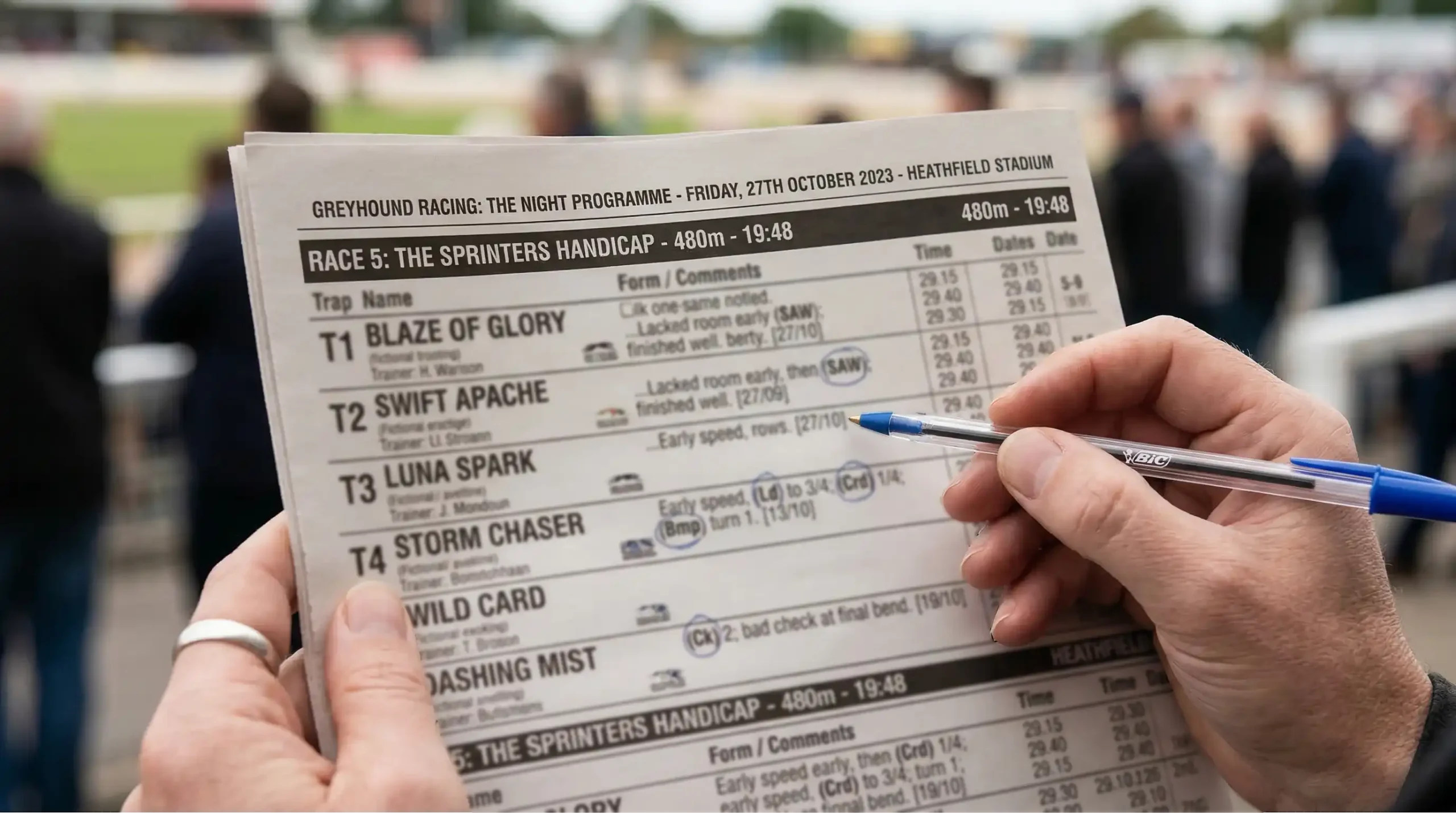
Every greyhound racecard tells a story, but that story is written in code. SAW, Ld, Crd, Bmp, Ck. These abbreviations appear in the comments column of form guides across Britain, and if you cannot read them, you are missing half the picture. Understanding what happened in a dog’s previous races is essential for predicting what might happen next. The wider context is set out in our UK greyhound track results guide.
The abbreviation system exists because space is limited. A racecard must condense complex race narratives into a few characters. A comment like SAw,Ld1-3,Crd4,RanOn tells an entire story: slow away from the traps, led from the first to the third bend, crowded at the fourth bend, then ran on to the line. Once you crack the code, form study becomes infinitely more revealing.
British greyhound racing uses a standardised set of abbreviations across all GBGB-licensed tracks. Whether you are studying form from Towcester or Newcastle, the same codes apply. This guide covers the most common abbreviations you will encounter, organised by category to help you build a working vocabulary for reading racecards.
Position Abbreviations
The most common abbreviations describe where a dog raced at various points of the race. Ld means led, indicating the dog was in front. This can be qualified with bend numbers: Ld1 means led at the first bend, Ld1-3 means led from the first bend through to the third. ALd means always led, the clearest indication of a front-running performance. When you see ALd in a dog’s recent form, you know what to expect at the break.
Numbers alone indicate finishing position when combined with distances. 1st indicates a winner, but form often shows positions at each bend. A comment reading 3-2-1-1 shows a dog that was third at the first bend, second at the next checkpoint, then first from there to the finish. This progression tells you the dog finished strongly from behind, which is valuable information when assessing its likely racing pattern.
Chl means challenged, showing the dog was racing close to the leader without actually being in front. Disp means disputed, typically used when two or more dogs contested the lead together. These abbreviations appear when the race for first place was competitive rather than one-sided.
Tracking abbreviations describe dogs that follow rather than lead. Trckd means tracked, indicating a dog that sat behind the leader. The record of 1.07 per cent injury rate across GBGB racing in 2024 reflects careful monitoring of incidents that these abbreviations help document, with detailed race comments providing evidence for any welfare investigations.
Handy means the dog raced in a prominent position without necessarily leading. Mid means the dog raced in the middle of the field. Wide and Rails describe the lateral position on the track rather than the place in the race. These positional abbreviations help build a picture of how a race unfolded spatially across the track.
Running Style Abbreviations
Running style abbreviations reveal how a dog races, which is often more important than where it finished. EP means early pace, indicating a dog that breaks quickly from the traps. QAw means quick away, describing a fast start. SAw or SlAw means slow away, suggesting the dog lost ground at the break. The difference between a quick start and a slow one can determine the entire outcome of a race.
These early-race abbreviations are crucial for handicapping. A dog that consistently shows EP or QAw is likely to contest the lead. One marked SAw regularly faces an uphill battle, needing to overcome that slow start. When studying form, note whether slow starts are typical or unusual for a particular dog. A single SAw among otherwise quick breaks might indicate a problem on the day rather than a habitual pattern.
RanOn means the dog finished strongly, running past tiring rivals in the closing stages. Styd means stayed on, similar to ran on but perhaps with less dramatic finishing speed. FinWl means finished well. These abbreviations identify closers, dogs that might benefit from longer trips or from races where early pace is strong and leaders tire. Knowing a dog finishes well is valuable when it draws an outside trap and faces a task to make the first bend.
Fdd or Faded means the dog weakened in the latter stages. Wtd means waited, indicating the dog was held up deliberately or naturally ran with restraint before attempting to finish. Outpcd means outpaced, suggesting the dog could not match the speed of rivals at a particular point in the race.
RlsRn means rails run, describing a dog that stuck to the inside rail throughout. WideRn means wide run, the opposite. These lateral running styles matter because they indicate how a dog will handle its trap draw. A rails runner drawn in trap six faces a challenge cutting across to find the fence.
Clr means clear, indicating daylight between the dog and its nearest rival. This abbreviation often appears with winning comments: Led,Clr suggests a dog that led and pulled away convincingly. The margin of a victory matters for understanding class.
Incident and Interference Abbreviations
Racing incidents leave their mark in the form comments. Bmp means bumped, indicating physical contact with another runner. Crd means crowded, suggesting the dog lost ground because rivals squeezed it for room. Ck or Ckd means checked, describing a situation where the dog had to slow or alter course to avoid trouble.
These interference abbreviations are vital for form analysis. A dog that finished poorly after being marked Bmp3,Crd4 might have run much better without the trouble. Conversely, a dog that consistently shows interference might be running a line that invites it, suggesting the problem could recur.
Blk means baulked, a more severe interference where the dog was almost stopped by trouble ahead. Fll means fell, the most serious incident type. The GBGB recorded 123 fatalities across racing in 2024, with fall-related incidents contributing to this figure. Form comments documenting falls and their circumstances are taken seriously in ongoing welfare monitoring.
StbdUp means stumbled up, usually occurring at the first bend when a dog loses its footing. RanInto means the dog collided with another runner. Bckd means backed off, suggesting the dog deliberately slowed to avoid trouble ahead.
For comprehensive form study, check sources like Timeform, which provide detailed race comments alongside these abbreviations. Their analysis often expands on what the abbreviated comments suggest, giving context that single letters cannot convey.
Understanding these abbreviations transforms your reading of racecards. Instead of glancing at finishing positions, you can reconstruct entire races in your mind. That SAw comment explains why the usual front-runner finished fourth. That Crd4 tells you the dog was unlucky when challenging. These details matter because they reveal potential that results alone cannot show. A dog that finished fifth after trouble might be a better bet next time than one that finished third with a clear run. The card they appear on is decoded in the racecard guide.
The abbreviation system is standardised across British greyhound racing, so once you learn it, you can read form from any track. Practise by watching races and then reading the comments afterwards. Soon you will be thinking in abbreviations, automatically translating SAw,Bmp1,RanOn into the story of a dog that started slowly, got bumped at the first bend, then ran on gamely to the line.
