
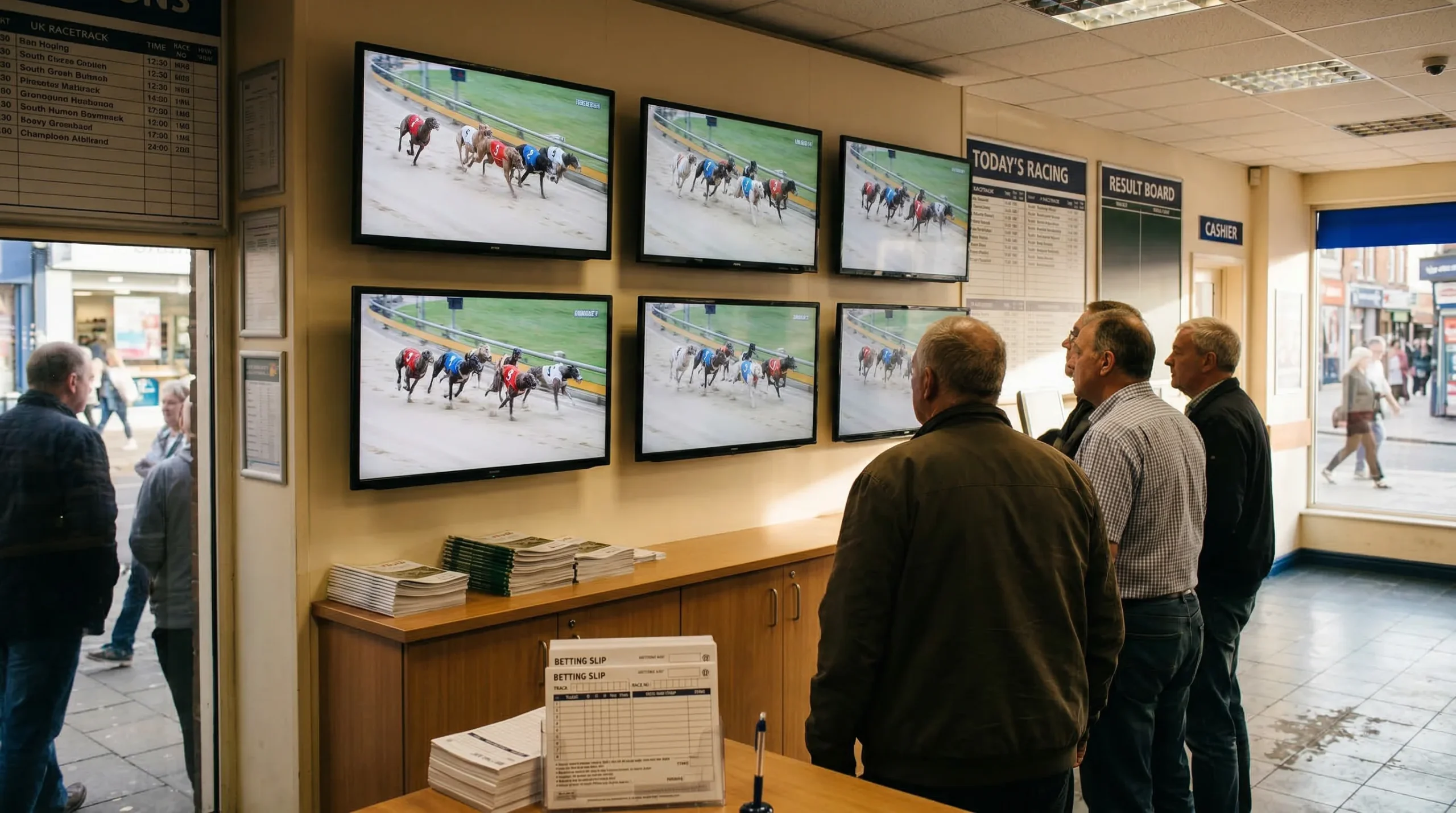
If you have ever walked into a betting shop during daylight hours and noticed greyhound racing on the screens, you have encountered BAGS. The acronym stands for Bookmakers Afternoon Greyhound Service, and it represents the backbone of daily greyhound racing in Britain. While evening meetings draw crowds to the stadiums, BAGS keeps the sport running throughout the day for a different audience entirely. The wider context is set out in our UK greyhound track results guide.
BAGS racing exists primarily for betting shop customers. These afternoon and morning meetings provide a continuous stream of content for punters who want to have a bet during working hours without waiting for the evening cards. The races are broadcast directly to licensed betting shops and streaming platforms, creating a product specifically designed for the off-course market. It is a remarkable piece of infrastructure that keeps greyhound racing economically viable in an era of declining trackside attendance.
What Is BAGS
The Bookmakers Afternoon Greyhound Service emerged from a simple commercial reality. Betting shops needed content. Horse racing does not run continuously throughout the day, leaving gaps that needed filling. Greyhound racing, with its quick turnaround between races and lower operational costs, provided the perfect solution. BAGS created a system where tracks could host racing during off-peak hours specifically for the betting market.
The financial model differs significantly from evening racing. BAGS meetings are funded through media rights payments from bookmakers rather than gate receipts and on-course betting. This arrangement means the quality of racing matters less than the regularity. A steady stream of competitive races keeps the screens active and the betting slips flowing. With betting turnover on greyhounds reaching approximately £1.5 billion annually, the economic significance of this daytime product cannot be overstated.
Racing takes place in front of minimal crowds, sometimes none at all. The focus is entirely on the broadcast. Cameras capture the action, commentators provide the narrative, and the signal goes out to thousands of betting shops across Britain. For many tracks, BAGS meetings represent a crucial revenue stream that supplements their more glamorous evening fixtures. The absence of spectators does not diminish the racing itself, though it does create an unusual atmosphere for those who attend.
The service is coordinated centrally, with scheduling designed to minimise clashes between tracks and ensure continuous coverage throughout the betting day. This coordination means punters always have a race to watch and bet on, typically with new action every five to ten minutes during peak periods. The efficiency is remarkable, turning greyhound racing into a kind of continuous product that betting shops can rely on to keep their screens populated with live sport.
BAGS racing uses the same rules and grading system as evening meetings. The dogs are fully registered with the GBGB, the trainers are licensed, and the welfare standards apply equally. What changes is the context, not the quality of the sporting contest itself. A graded race at noon follows the same format as one at eight in the evening. The starting price mechanism works identically, and the same betting markets are available.
Participating Tracks
Not every greyhound stadium participates in BAGS racing, but most of the 18 GBGB-licensed tracks in Britain do host afternoon meetings at some point during the week. The major BAGS venues include Crayford, Monmore, Romford, Sheffield, and Perry Barr, among others. Each track takes its allocated slots in the schedule, rotating through the week to ensure coverage across the betting day.
Some tracks have become particularly associated with BAGS racing due to their scheduling. Venues in industrial areas or those without strong evening attendance often lean heavily into the daytime model. For these stadiums, BAGS meetings might represent the majority of their racing activity, with evening meetings reserved for special events or weekends. The commercial imperative is clear: media rights payments from BAGS contracts provide financial stability that ticket sales alone cannot guarantee.
The geographic spread of BAGS tracks means the signal comes from various locations throughout the day. A morning meeting might originate from one end of the country, followed by an afternoon card from somewhere else entirely. This variety keeps the product fresh, with different track configurations and local conditions adding interest for regular punters who watch multiple meetings daily.
Track quality remains consistent across BAGS meetings because the same surface maintenance and safety standards apply. The Sports Turf Research Institute conducts regular inspections regardless of whether a meeting is designated BAGS or evening. What you see on the betting shop screens represents genuine competitive racing on properly maintained tracks, not some inferior secondary product.
Schedule and Format
BAGS racing follows a structured timetable designed around betting shop opening hours. Morning meetings typically begin around ten or eleven and run through to early afternoon. Afternoon cards then take over, continuing until the evening meetings begin at most tracks. This creates an overlapping schedule that ensures continuous action throughout the day, with rarely more than a few minutes gap between races across the network.
A typical BAGS meeting comprises twelve to fourteen races, spread across approximately two to three hours. The intervals between races are tight, usually around eight to ten minutes, maximising the number of betting opportunities within the session. This rapid turnover is deliberate, keeping screens active and punters engaged. The pace suits the betting shop environment where customers expect constant action.
Race distances at BAGS meetings mirror those at evening fixtures. Standard sprints over 480 metres dominate, with shorter 265-metre dashes and longer 640-metre or marathon distances providing variety. The grading system operates identically, meaning an A3 race at a BAGS meeting carries the same competitive standard as an A3 race in the evening. Trainers enter their dogs according to form and fitness, not according to the time of day.
Viewing options for BAGS racing extend beyond the betting shop. SIS and other providers stream the action to licensed premises and online platforms. Bookmaker websites and apps often embed the live stream directly into their greyhound betting pages, allowing customers to watch while placing bets from home or mobile devices. This multi-platform availability has expanded the audience beyond traditional betting shop regulars.
The format suits certain types of punters particularly well. Those who prefer form study over atmosphere find BAGS meetings easier to analyse, with results and racecards readily available online. The regular scheduling means you can watch the same trainers and dogs compete at predictable times, building familiarity with the animals and their form patterns. For serious students of the form book, BAGS racing offers a laboratory for testing theories without the distractions of a crowded evening meeting.
BAGS has evolved from a gap-filler into a product with its own dedicated following. The punters who bet through afternoon meetings often prefer the methodical nature of the format over the social experience of attending evening racing. They treat it as a different sport almost, one where data and form take precedence over atmosphere and occasion. The dogs do not know the difference, but the humans watching certainly approach it differently. Watching those cards is covered in live racing.
Understanding BAGS is essential for anyone who bets regularly on greyhounds. The daytime meetings offer more opportunities to bet, more races to study, and more chances to develop expertise on specific tracks and trainers. Whether you view it as convenient content or a dedicated pursuit, BAGS racing forms the foundation of daily greyhound betting in Britain.
