
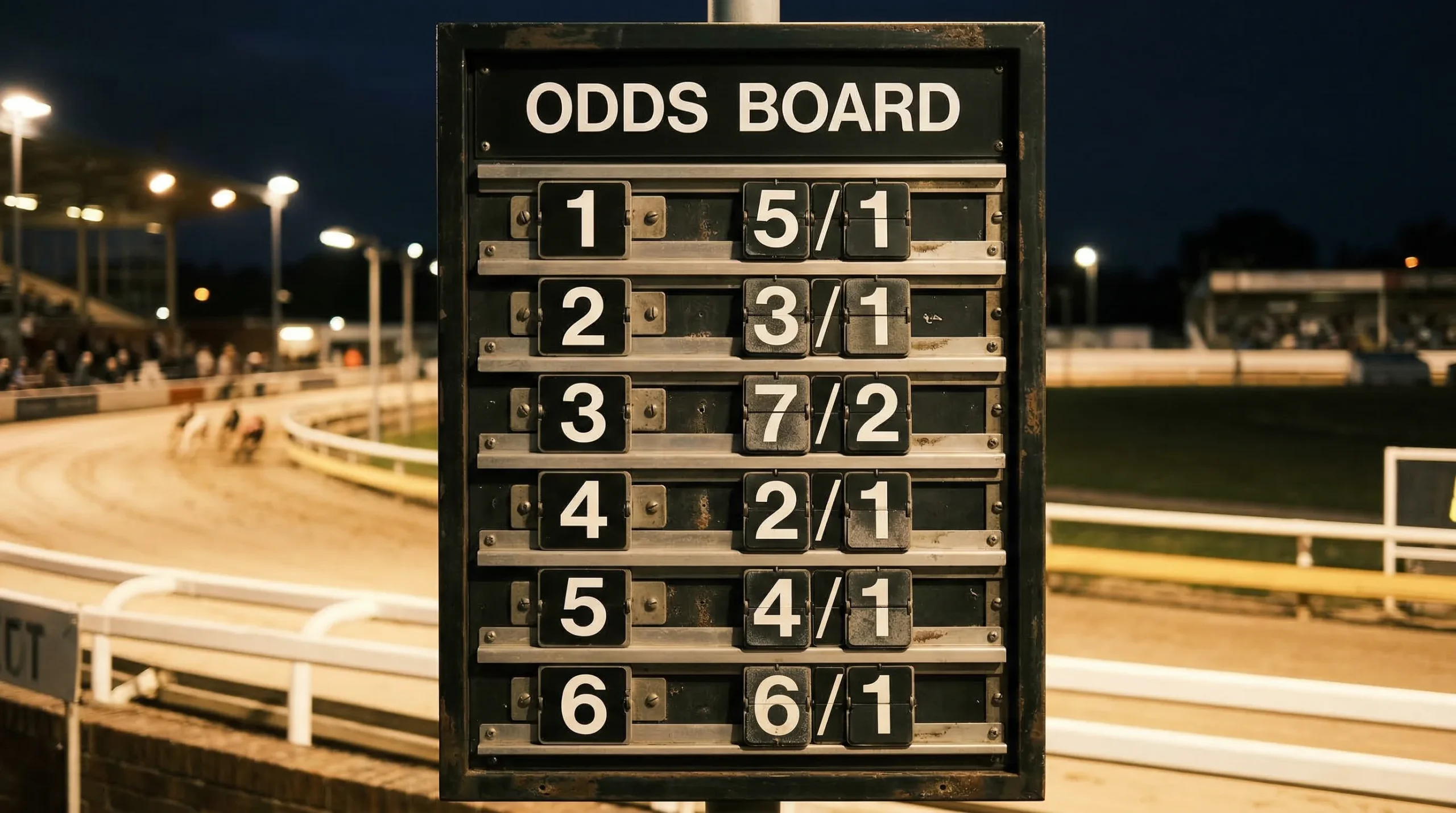
Understanding greyhound betting types requires familiarity with the range of wagers available and how each operates. From simple win bets to complex combination forecasts, the betting menu at greyhound tracks offers options suited to different approaches and risk appetites. This guide explains the mechanics of each bet type without promoting gambling itself, serving as an informational resource for those seeking to understand how greyhound betting works. The full picture is in our UK greyhound track results guide
Greyhound racing has historically maintained close ties to the betting industry. The sport receives significant funding from bookmaker contributions, and tracks derive substantial revenue from on-course wagering. Understanding the betting dimension is therefore part of understanding the sport, even for those with no intention of placing bets themselves.
The following sections cover the main bet types in detail, explain the odds formats used in British greyhound racing, compare starting price mechanisms, and provide context on the betting industry’s relationship with the sport. Throughout, the focus remains on explanation rather than recommendation, presenting information that enables informed understanding.
Win, Place and Each-Way Bets
Win bets represent the simplest wager in greyhound racing. You select a dog, and if it finishes first, the bet wins. The payout depends on the odds at the time of settlement, whether those are the price taken when the bet was placed or the starting price if no specific price was requested. Win betting requires no complex calculation or combination; the question is simply whether your selection crosses the line ahead of the other five runners.
The appeal of win betting lies in its directness. Each race has one winner, and either your dog is that winner or it is not. This binary outcome makes win bets easy to understand and evaluate. However, the simplicity comes with a corresponding requirement: your selection must actually win. Second place pays nothing on a straight win bet.
Place Betting
Place bets offer insurance against narrow defeats. In greyhound racing, a place bet typically covers the first two finishers. If your selection finishes first or second, the place bet wins. The odds for place bets are lower than win odds, reflecting the increased probability of success. A dog at 5/1 for the win might be offered at 2/1 for a place.
Place betting suits those who identify likely contenders without confidence that they will actually win. A dog that figures to be involved at the finish but might not quite get there becomes a place candidate. The reduced payout compensates for the improved chance of collecting.
Each-Way Betting
Each-way bets combine win and place betting into a single wager. An each-way bet is actually two bets: one for the win and one for the place. If your selection wins, both parts pay out. If it finishes second, only the place portion returns. If it finishes third or worse, both parts lose.
The each-way stake doubles the total investment. A £5 each-way bet costs £10, comprising £5 on the win and £5 on the place. Returns depend on whether the dog wins or places, with win payouts reflecting the full odds and place payouts reflecting the reduced place terms.
Standard greyhound place terms pay one quarter of the win odds for a place. A dog at 8/1 returns 2/1 for the place portion. Some bookmakers offer enhanced place terms for specific races, paying one third or even one half the odds, improving the place value.
Each-way betting appeals to those seeking some return from near-misses while still benefiting fully from wins. The approach works best with longer-priced selections where the place return provides meaningful value. On short-priced favourites, the place portion returns very little, making each-way bets less attractive.
Multiple Bets
Win, place, and each-way bets can be combined into multiples covering several races. Doubles combine two selections, trebles combine three, and accumulators extend further. Each selection must win (or place, for each-way multiples) for the bet to succeed. The odds multiply together, producing potentially large returns from small stakes, but the requirement that every selection must deliver makes multiples difficult to win consistently.
Forecast and Tricast Bets
Forecast and tricast bets extend beyond picking winners to predicting finishing order. These bets offer higher potential payouts than simple win bets but require greater accuracy, asking bettors to identify not just which dogs will perform well but precisely how they will finish relative to each other.
Straight Forecast
A straight forecast requires selecting two dogs to finish first and second in exact order. If you select Dog A to win and Dog B to finish second, both must deliver those exact positions for the bet to succeed. Dog A second and Dog B first produces a losing bet, despite correctly identifying the first two home.
Forecast dividends are declared after each race, calculated based on the combination’s popularity relative to pool size. Less fancied combinations produce larger payouts than popular ones. A forecast linking two outsiders pays substantially more than one combining the favourite with the second favourite.
Reverse Forecast
Reverse forecasts cover both possible finishing orders for two selected dogs. Selecting Dog A and Dog B in a reverse forecast wins if A beats B or B beats A, provided no other dog finishes ahead of both. The reverse forecast costs double a straight forecast because it comprises two separate bets.
Reverse forecasts suit situations where you are confident two dogs will fill the first two positions but uncertain which will prevail. The increased cost is offset by the flexibility, though payouts are necessarily lower than a correctly predicted straight forecast would have been.
Combination Forecast
Combination forecasts extend the reverse principle to more than two selections. Selecting three dogs in a combination forecast covers all possible first-second pairings among those three. This means six separate bets (three choices for first, then two remaining for second), costing six times the unit stake.
The combinations increase rapidly with additional selections. Four dogs produce twelve combinations, five dogs produce twenty. Combination forecasts provide coverage but become expensive quickly, and the cost often outweighs the value unless payouts prove exceptionally generous.
Straight Tricast
Tricast betting extends prediction to the first three finishers. A straight tricast requires naming three dogs to finish first, second, and third in exact order. The difficulty increases substantially compared to forecasts, but so do potential payouts. Correctly predicting three positions from six runners requires either skill, luck, or both.
Combination Tricast
Combination tricasts cover all possible orderings of selected dogs for the first three positions. Three selections produce six combinations. Four selections produce twenty-four. Five selections produce sixty. The cost escalates rapidly, though the coverage provides substantial flexibility.
Most serious tricast players focus on straight predictions rather than expensive combinations. The skill involved in identifying the precise finishing order distinguishes tricast betting from more forgiving bet types, attracting those who believe their form analysis provides genuine predictive advantage.
Payout Structure
Forecast and tricast dividends depend on pool betting principles. The total money bet on forecasts or tricasts forms a pool, from which operator deductions are taken. The remaining money is distributed among winning tickets based on the number of successful combinations. Unusual results, with outsiders filling the places, produce larger dividends than predictable outcomes where favourites dominate.
Tote and Pool Betting
Pool betting, commonly called tote betting in the UK, operates on fundamentally different principles from fixed-odds bookmaker betting. Rather than offering predetermined odds, pool betting collects all wagers into a pool, deducts operating costs, and divides the remainder among winning ticket holders. The actual payout depends on how many people backed the winning outcome.
How Pool Betting Works
When you place a tote bet, your stake enters a pool with everyone else’s stakes on that race. After the race, the operator takes a percentage, typically around 20% for greyhound pools. The remaining money is divided by the number of winning units to produce the dividend, which is then applied to each winning stake.
This system means that odds fluctuate until betting closes. A dog attracting heavy support will pay less than one attracting minimal interest. Unlike fixed-odds betting, where you know your potential return when placing the bet, tote betting reveals returns only after the race.
Tote Win and Place
Tote win bets function like bookmaker win bets but with pool-determined dividends. Tote place bets pay on the first two finishers in standard greyhound races, with the place pool divided among backers of both placed dogs. The place dividend can vary significantly from the win dividend, sometimes offering better value on dogs that attracted win money but less place support.
Exacta and Trifecta
The exacta is the tote’s equivalent of the forecast, requiring selection of the first two finishers in order. The trifecta extends this to the first three finishers. Both operate on pool principles, with dividends declared after the race based on pool size and winning ticket count.
Exacta and trifecta pools tend to be smaller than win pools, meaning dividends can vary more dramatically. A surprising result on a small pool might produce exceptional returns, while a popular combination on a well-supported pool might pay modestly.
Jackpot and Exotic Bets
Some meetings offer jackpot pools requiring winners across multiple races. These accumulating pools grow until someone selects all winners, potentially producing substantial payouts. The difficulty of selecting multiple winners correctly means jackpots often roll over, building prize funds that attract attention beyond regular racegoers.
The total betting turnover on greyhound racing, including pool and fixed-odds wagers through all channels, reached approximately £1.5 billion in the year ending March 2023. This figure encompasses on-course betting at tracks, off-course betting in betting shops, and remote betting through online platforms. Pool betting represents a minority of this total, with fixed-odds bookmaker betting dominating the market.
Understanding Odds Formats
British greyhound racing traditionally uses fractional odds, though decimal and American formats appear on some platforms. Understanding how to read and convert between formats helps when comparing prices across different bookmakers or betting exchanges.
Fractional Odds
Fractional odds express potential profit relative to stake. Odds of 5/1, spoken as “five to one,” mean a successful £1 bet returns £5 profit plus the original £1 stake, for a total return of £6. The left number indicates potential profit, the right number indicates the stake required to earn it.
Odds shorter than evens use the larger number on the right. Odds of 1/2, spoken as “one to two” or “two to one on,” mean you must stake £2 to win £1 profit. A £2 bet at 1/2 returns £3 total: £1 profit plus the £2 stake. These odds indicate strong favourites expected to win more often than they lose.
Some fractional odds use non-standard numbers. Odds of 11/4 mean staking £4 to win £11 profit, or equivalently, a £1 bet returns £2.75 profit. Odds of 9/2 mean a £2 stake returns £9 profit. With practice, converting these becomes automatic, though most punters simply note whether odds are better or worse than alternatives without calculating exact returns.
Decimal Odds
Decimal odds express total return including stake. Odds of 6.00 mean a £1 bet returns £6 total if successful. To convert fractional to decimal, divide the left number by the right and add 1. So 5/1 becomes (5÷1)+1 = 6.00. Odds of 1/2 become (1÷2)+1 = 1.50.
Decimal odds simplify comparison because they directly show returns. Odds of 3.50 obviously pay more than odds of 3.25, while fractional equivalents of 5/2 and 9/4 require calculation to compare. European betting markets predominantly use decimal format, and many British platforms offer a format choice.
American Odds
American odds use positive and negative numbers. Positive odds indicate profit on a £100 stake: +500 means £100 returns £500 profit. Negative odds indicate the stake required to profit £100: -200 means staking £200 to win £100 profit. This format is uncommon in British greyhound racing but appears on some international platforms.
Converting Between Formats
Quick conversions help when comparing prices across platforms. For fractional to decimal: divide first by second, add 1. For decimal to fractional: subtract 1, express as fraction (may need simplification). For positive American to decimal: divide by 100, add 1. For negative American to decimal: divide 100 by the absolute value, add 1.
Most betting platforms display prices in multiple formats or allow format selection in settings. Understanding the underlying mathematics helps, but memorising common equivalents proves more practical. Knowing that 2/1 equals 3.00 equals +200, or that 1/3 equals 1.33 equals -300, covers frequently encountered prices.
Starting Price and Betfair SP
The starting price, or SP, represents the official odds at which bets are settled when no specific price was taken. Understanding how SP is determined, and how it differs from exchange-based alternatives like Betfair SP, helps in choosing when to take fixed prices and when to accept market-determined returns.
Traditional Starting Price
The starting price is determined by on-course bookmakers moments before each race. Industry representatives observe prices offered in the on-course betting ring and calculate an SP reflecting the available odds. This process aims to produce a fair market price at the moment of race start.
SP bets defer price determination until after the race. You back a dog without specifying odds, and the SP at race start determines your return if successful. This approach suits those who cannot monitor prices closely or who prefer market-determined prices to potentially stale early odds.
The traditional SP has faced criticism that on-course betting rings have shrunk, reducing the robustness of the price formation process. With fewer on-course bookmakers, the SP may reflect a thinner market than it once did, potentially producing prices that diverge from true market equilibrium.
Betfair Starting Price
Betfair SP offers an exchange-based alternative, derived from betting activity on the Betfair betting exchange. Rather than relying on on-course bookmakers, BSP reflects the combined back and lay prices on the exchange at race start, weighted by volume.
For many greyhound races, BSP produces prices similar to traditional SP. For others, meaningful differences emerge. Exchange activity sometimes identifies value or risk that on-course markets miss, and the transparency of exchange pricing provides verifiable data that traditional SP lacks.
Some bettors systematically compare SP and BSP, seeking the better option for each selection. Others default to one or the other based on convenience or preference. The optimal choice depends on race type, market liquidity, and individual betting patterns.
Best Odds Guaranteed
Many bookmakers offer best odds guaranteed promotions, paying the higher of the taken price or SP if SP proves better. This arrangement removes downside risk from taking early prices while preserving upside if markets move favourably. For greyhound bettors, BOG offers can make early-price betting more attractive, knowing that SP improvements will be captured.
BOG terms vary between bookmakers and sometimes between race types. Some exclude certain tracks, meeting types, or bet sizes. Checking specific terms before relying on BOG protection avoids disappointment when expected payouts differ from received ones.
The Betting Industry and Greyhound Racing
Greyhound racing and the betting industry exist in mutual dependence. The sport provides betting content for bookmakers, while bookmaker contributions fund prize money, welfare initiatives, and operational costs. Understanding this relationship provides context for how the sport operates financially.
Bookmaker Contributions
The British Greyhound Racing Fund collects voluntary contributions from bookmakers based on a percentage of greyhound betting turnover. The current contribution rate stands at 0.6% of turnover, generating £6.75 million in the 2024-25 financial year. This money supports the sport through prize money contributions, welfare funding, and infrastructure investment.
The voluntary nature of these contributions distinguishes greyhound racing from horse racing, which receives statutory levy payments. Greyhound racing has long sought statutory status similar to horseracing, arguing that voluntary arrangements leave funding vulnerable to bookmaker decisions. Legislative changes have been discussed but not implemented. How the prices are built is in how odds are set.
Betting Turnover Trends
Greyhound betting turnover has declined in recent years. Analysis shows a 15% drop from £2.12 billion in 2020 to £1.81 billion in 2024. In real terms, adjusting for inflation, the decline reaches approximately 23% over the past three years. This contraction affects the entire sport, from prize money to track viability.
Multiple factors contribute to declining turnover. Competition from other betting products, including football, virtual sports, and casino games, draws attention from traditional greyhound markets. Reduced media coverage compared to the sport’s peak decades diminishes public awareness. Track closures reduce the volume of racing available to bet on, creating a potential negative feedback loop.
BAGS Racing
The Bookmakers Afternoon Greyhound Service provides racing content for betting shops throughout the day. BAGS fixtures run at multiple tracks, scheduled to fill periods when other sports provide less betting opportunity. This service generates substantial turnover, making tracks that host BAGS meetings more financially viable than those relying solely on evening audiences.
BAGS racing emphasises quantity and convenience over prestige. The races provide betting content rather than sporting spectacle, and the dogs competing are often modest graders rather than open-class performers. Nonetheless, BAGS meetings sustain many tracks financially and provide racing opportunities for dogs that might otherwise lack competitive outlets.
Responsible Gambling Context
Any discussion of betting types should acknowledge that gambling carries risks. Greyhound racing, like other forms of betting, can lead to problem gambling for vulnerable individuals. The UK Gambling Commission regulates the industry, requiring operators to implement responsible gambling measures including deposit limits, self-exclusion options, and signposting to support services.
This guide presents information about how greyhound betting works, not recommendations to bet. Understanding the mechanics of different bet types and odds formats serves educational purposes, enabling informed choices for those who choose to participate while providing context for those studying the sport’s operation more broadly.
