
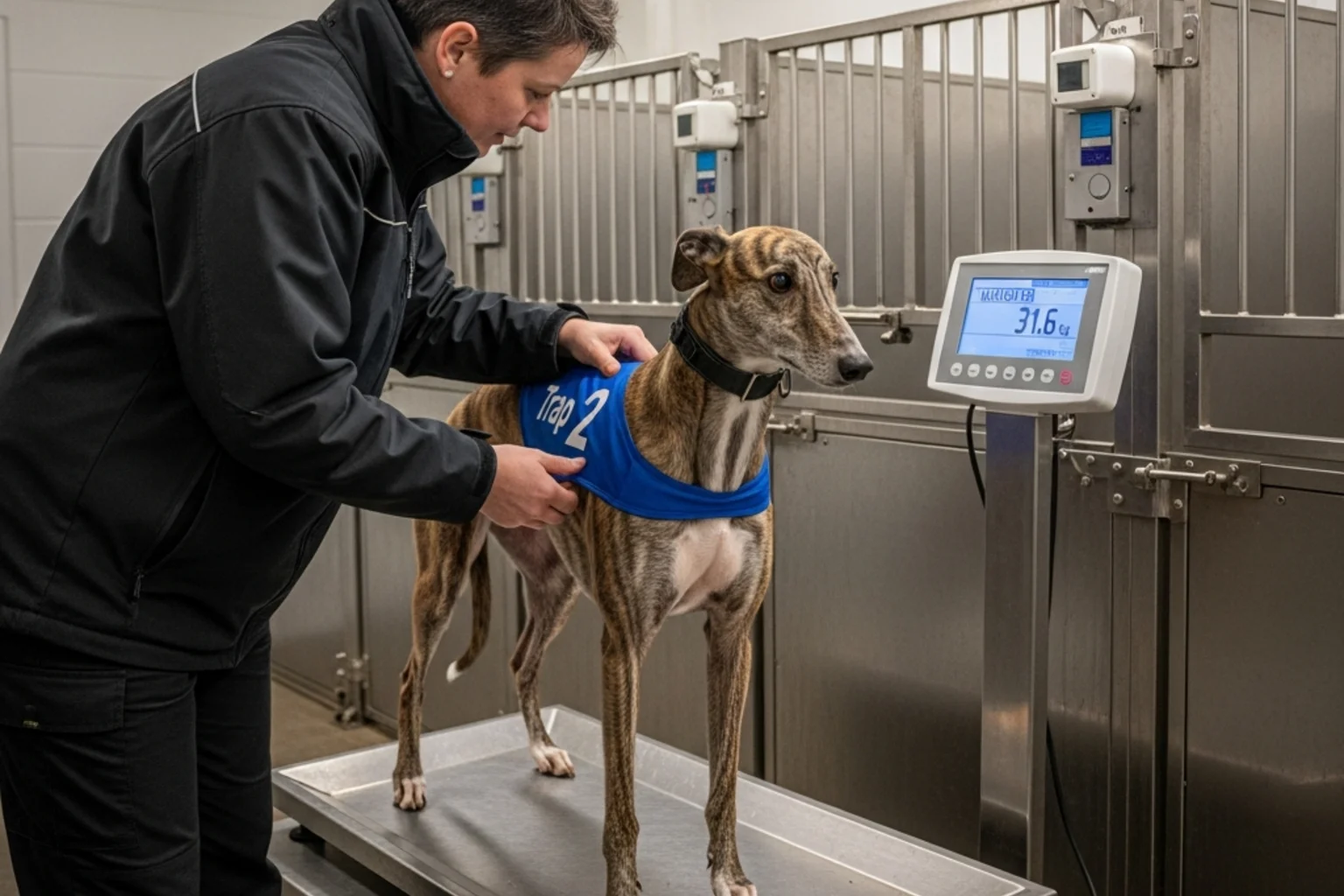
Every greyhound racecard in the UK displays a figure that casual observers often overlook: weight. Listed in kilograms to one decimal place, this number tells experienced punters more than breed or trap draw ever could. A greyhound’s racing weight reflects its current condition, fitness level, and readiness to compete. Understanding what these figures mean — and, crucially, what changes between races signify — separates informed analysis from guesswork. The wider context is set out in our UK greyhound track results guide.
Weight matters because greyhound racing is a sport of fine margins. A dog carrying an extra kilogram might lose half a length over 480 metres. One that has dropped weight rapidly could be underprepared or, worse, unwell. The GBGB requires all licensed trainers to weigh their greyhounds before every race, and this data becomes part of the permanent record. Your job is to interpret it.
Unlike horse racing, where jockey allowances and handicap weights dominate discussion, greyhound weight analysis focuses entirely on the dog itself. There are no saddles, no riders, no equipment variations. The number on the racecard represents lean muscle, bone, and conditioning — the raw materials of racing performance. This makes weight fluctuations particularly revealing.
Optimal Racing Weight: Finding the Sweet Spot
There is no single ideal weight for a racing greyhound. A 35kg dog built for sprint distances will have different optimal parameters than a 30kg stayer bred for stamina races. What matters is not the absolute number but whether that particular greyhound is racing at its personal best weight — the point where muscle mass, hydration, and fitness converge to produce peak performance.
Most British racing greyhounds weigh between 26kg and 38kg, with dogs at the heavier end typically excelling over shorter distances where raw power matters. Lighter greyhounds often fare better in stayer events, where carrying less mass over 600 metres or more becomes an advantage. Trainers spend considerable effort finding each dog’s sweet spot, and the GBGB has invested in professional development to ensure this expertise spreads across the sport. In 2024, industry participants completed over 580 hours of Continuing Professional Development courses covering topics including nutrition and conditioning.
A greyhound’s optimal weight tends to remain remarkably consistent throughout its racing career, varying by no more than one or two kilograms from peak to trough. When a dog repeatedly posts its best times at, say, 32.4kg, that becomes its benchmark. Trainers work to keep their charges within a narrow band of that figure, adjusting feeding regimes, exercise schedules, and rest periods to maintain condition.
Bitches generally race lighter than dogs, though there are always exceptions. Seasonal variations also play a role: greyhounds often carry slightly more weight in winter, when thicker coats and reduced activity can add a few hundred grams. None of this represents a problem, provided the change falls within expected parameters. The concern arises when weight shifts outside a dog’s established range.
Interpreting Weight Changes Between Races
The racecard shows a greyhound’s current weight alongside the change from its previous outing, displayed as a plus or minus figure. A notation of “32.2 +0.3” indicates the dog weighs 32.2 kilograms, up 300 grams from its last race. This simple data point opens a window into the kennel’s recent activities.
Small fluctuations of 200 to 300 grams in either direction rarely cause concern. These shifts reflect normal variation — perhaps a slightly larger meal, a different weigh-in time, or minor hydration differences. Experienced analysts barely register such movements, focusing instead on larger or sustained changes that might indicate something more significant.
A gain of 500 grams or more warrants attention. It could mean the greyhound has been rested and is returning from a break, potentially carrying extra condition that will sharpen with racing. Alternatively, it might suggest reduced training intensity, which could affect early pace. Context matters: check the dog’s recent race history to understand why the weight has increased.
Weight loss demands closer scrutiny. A drop of 300 to 500 grams often indicates a greyhound that has been working hard in training, building fitness for a specific target race. Trainers sometimes “dry out” dogs slightly before important events, reducing food and water intake to bring them down to their optimal racing weight. This is normal practice and, when done correctly, produces sharper performances.
However, weight loss beyond 500 grams between consecutive races raises questions. The dog might be recovering from illness, struggling with the demands of frequent racing, or experiencing stress in the kennels. None of these scenarios favour backing the greyhound with confidence. Similarly, a pattern of declining weight over several races suggests something is amiss, even if each individual drop seems modest.
The most useful approach combines weight data with form analysis. A greyhound that has gained weight but won its last three races clearly handles the extra condition. One that has lost weight while finishing further from the winner each time might be struggling. Neither weight gain nor weight loss is inherently good or bad — the question is always what it means for this particular dog in this particular situation.
Using Weight Data in Your Analysis
Integrating weight analysis into your racecard study requires building a picture of each greyhound’s history, not just glancing at today’s figure. The current weight means little without knowing where that dog typically performs best. Most results databases and form guides include weight records going back several races, allowing you to establish each greyhound’s racing range.
Start by identifying the weight at which a greyhound has produced its fastest times or most consistent finishing positions. Look for patterns: does this dog run better when slightly heavier, suggesting power over pace, or does it shine when trained down to a lean racing weight? Some greyhounds are remarkably consistent, always racing within a 400-gram window. Others fluctuate more widely without obvious performance impact, indicating resilience to weight variation.
Track conditions add another layer to weight analysis. Heavier greyhounds sometimes struggle on rain-affected surfaces where extra mass becomes a hindrance through the bends. Lighter dogs may lack the power to blast from the traps on firm going but compensate with stamina as races progress. The UK’s variable weather means surface conditions change frequently, making weight-to-going comparisons worthwhile.
Injuries occasionally reveal themselves through weight data before becoming obvious in race performance. The GBGB recorded an injury rate of just 1.07% across 355,682 races in 2024, the lowest on record, but dogs recovering from minor knocks often shed weight as training intensity decreases. A greyhound returning from a layoff with significant weight loss might still be rebuilding fitness, regardless of what the comments on the racecard say.
Consider also the trainer’s approach. Some kennels race their greyhounds heavier, prioritising power and early pace. Others train down to finer margins, producing dogs that peak late in races but risk fading if conditions turn testing. Once you recognise these patterns, weight data becomes a confirmation tool: this trainer always races dogs heavy, so today’s higher figure is normal; that kennel works dogs down sharply, so the lower weight signals serious intent. Where the weight appears is on the racecard.
Ultimately, weight is one tool among many. It confirms or challenges what form figures suggest, adds nuance to trainer patterns, and occasionally provides the decisive edge when two greyhounds appear otherwise equal. The punters who track weight methodically, noting each dog’s optimal range and flagging unusual movements, give themselves an advantage over those who ignore the data entirely. In a sport where small margins determine outcomes, that advantage compounds over time.
