
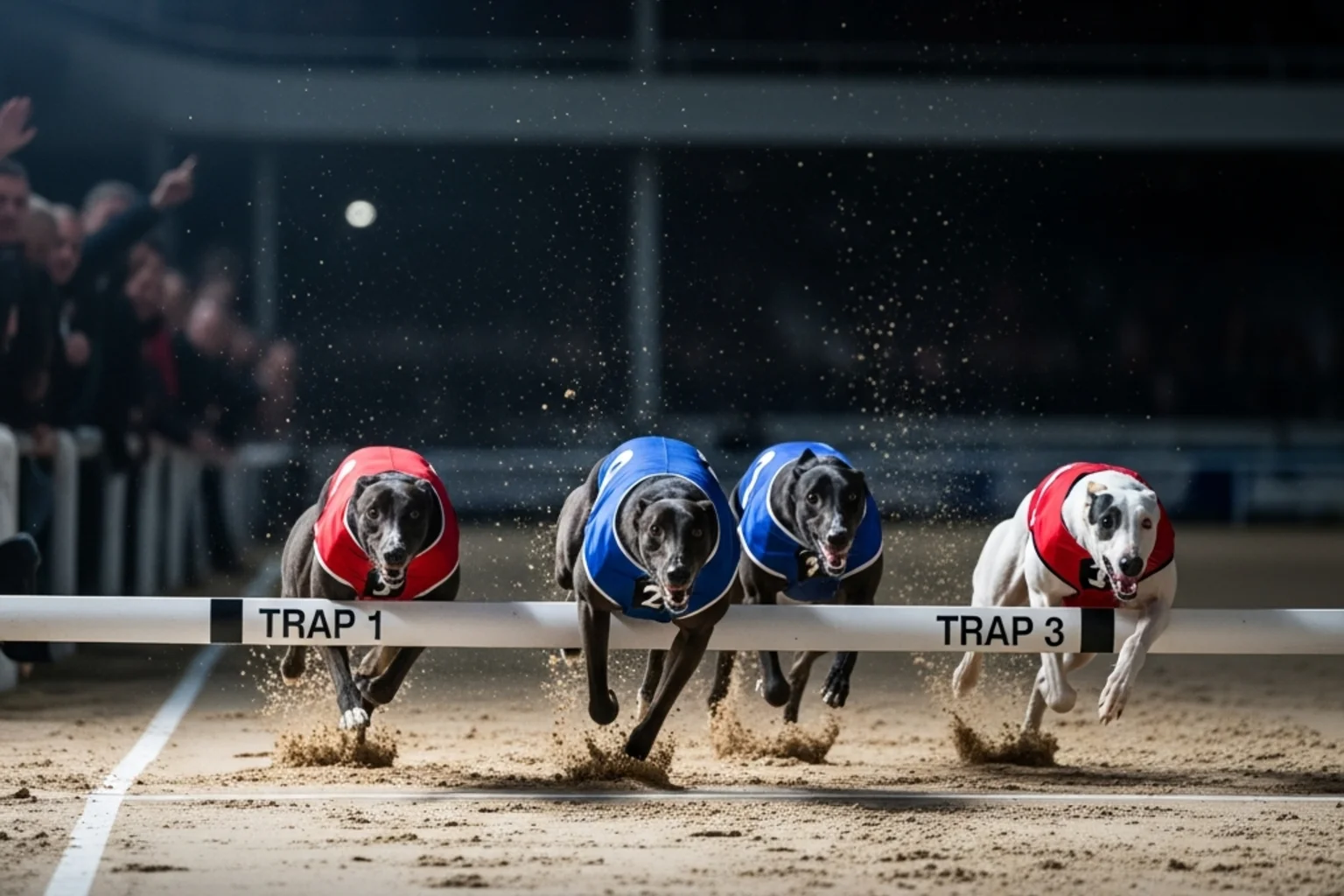
Forecast and tricast bets offer greyhound punters the chance to turn modest stakes into substantial returns. Instead of simply picking a winner, these bet types require predicting the exact order of the first two or three dogs to finish. The difficulty increases, but so do the potential payouts. The wider context is set out in our UK greyhound track results guide.
These bets suit greyhound racing particularly well because six-runner fields create manageable combinations while still offering meaningful odds. With betting turnover on greyhounds reaching approximately £1.5 billion annually, forecasts and tricasts represent a significant portion of wagers placed on the sport.
This guide explains how each bet type works, the variations available, and how payouts are calculated so you can make informed decisions about when these bets offer value.
Forecast Bet Types
A straight forecast requires you to predict the first two dogs to finish in exact order. You nominate which dog will win and which will come second. Both predictions must be correct for the bet to pay out. If your selections finish first and second but in reversed positions, the bet loses entirely.
The straight forecast offers the highest potential return among forecast variations because it is the hardest to land. In a six-runner race, there are 30 possible finishing combinations for the first two places. Your single selection must match the exact outcome from all these possibilities. The odds reflect this difficulty accordingly.
A reverse forecast covers both possible orders of your two selected dogs. If you pick dogs A and B, the bet pays whether they finish A first and B second, or B first and A second. This doubles your stake compared to a straight forecast but significantly increases your chances of collecting a return. The payout will be based on whichever combination actually occurs in the race.
Combination forecasts allow you to select more than two dogs, covering all possible first and second place combinations among them. Selecting three dogs gives you six combinations to cover. Selecting four gives you twelve. The stake multiplies accordingly, but so do your chances of winning. This approach works well when you cannot separate several contenders for the first two positions.
Bookmakers offer forecast betting at fixed odds or through the Computer Straight Forecast, which calculates returns based on starting prices after the race. The CSF typically produces fair returns but can occasionally pay significantly better or worse than fixed odds depending on market movements. Understanding which format you are using matters for managing your expectations about potential returns.
The tactical use of forecasts involves identifying races where the likely first two dogs are clearer than the exact order between them. Reverse forecasts shine in these situations where you are confident about which dogs will fill the places but not their precise order. Straight forecasts make sense when you have strong conviction about exact finishing positions.
Tricast Explained
A tricast requires predicting the first three dogs to finish in exact order. This extends the forecast principle by adding a third selection. The difficulty increases substantially because you must now be correct about three positions rather than two. In a six-runner race, 120 possible combinations exist for the first three places, making this significantly harder than forecasts.
Straight tricasts demand exact order for all three selections. Your first pick must win, your second pick must finish second, and your third pick must finish third. Any deviation from this means the bet loses entirely. This precision requirement produces the highest potential returns among standard greyhound bets.
Combination tricasts work similarly to combination forecasts. You select more than three dogs and cover all possible first, second, and third place combinations among them. Selecting four dogs gives you 24 combinations. The stake escalates quickly with each additional selection, but multiple winning possibilities increase your chances of landing the bet.
The Computer Tricast calculates returns based on starting prices after the race finishes. This official dividend applies to tote and pool betting on tricasts. Bookmaker tricasts may use the Computer Tricast formula or offer fixed odds depending on the operator and the specific bet structure.
Tricasts make sense when you have strong opinions about multiple positions in the race. If you are confident about the winner but less certain about second and third, a forecast might serve better. If you believe you can identify the likely first three finishers with reasonable confidence, the tricast offers superior returns for that conviction.
The challenge lies in consistently identifying races where the first three positions are predictable. Graded races with clear class differences might produce more predictable outcomes than open races where the field is tightly matched. Course-and-distance form can help separate contenders when ability levels appear similar on paper.
Payout Calculations
Computer Straight Forecast and Computer Tricast returns are calculated using official formulas based on starting prices. The calculations account for the odds of each placed runner, producing dividends that reflect market assessment of the finishing combination’s likelihood. These official returns apply to pool betting and many bookmaker forecasts.
The formula for CSF multiplies factors derived from starting prices of the first and second placed dogs. Without going into mathematical detail, higher odds for the placed dogs produce higher returns. A 10/1 winner beating a 5/1 second pays more than a 2/1 winner beating an evens second. The relationship is not linear but reflects probability weighting.
A portion of betting turnover supports greyhound racing through the British Greyhound Racing Fund. Bookmakers contribute 0.6 per cent of greyhound betting turnover to the BGRF, funding welfare initiatives and industry operations. This levy comes from total turnover rather than specific bet types, but it contextualises the economic relationship between betting and the sport.
Fixed odds forecasts and tricasts pay the stated price if your bet wins. The advantage is knowing your potential return before the race. The disadvantage is that bookmakers set prices that ensure their edge. Comparing fixed odds to likely CSF returns helps identify which approach offers better value on specific bets.
Returns on combination bets are calculated per winning line. If you place a three-dog combination forecast covering six possible outcomes and one wins, you receive the return for that specific combination. Your total stake covered six bets, but only the winning combination pays out. Understanding this prevents confusion about returns relative to total stake. The pool alternative is tote betting.
As Defra has noted regarding greyhound welfare more broadly, all animals involved in sport deserve the highest level of care. This principle extends to the betting ecosystem that supports racing, where transparent payout structures and fair odds contribute to a sustainable industry. The commercial health of greyhound betting affects the resources available for welfare improvements, creating connections between how we bet and how dogs are cared for.
